
Cyber

Cyber Defense That Learns, Adapts & Fights Back
Autonomous cyber agents. AI-enabled deception. Adversarial machine learning. Operational mission experience. Roysdon Defense Technologies develops advanced cyber capabilities for environments where static rules, signatures, and periodic vulnerability scans are no longer enough.
Our approach combines artificial intelligence, reinforcement learning, cyber deception, adversarial machine learning, synthetic data, network analytics, and autonomous agents to help defenders understand how an adversary can attack a system—and how the system can adapt before the adversary succeeds.
RDT builds on decades of national-security engineering and the prior work of founder Dr. Roysdon across the Department of Defense and Intelligence Community, including advanced CyberAI research, operational deployments, and successful research programs with DARPA, IARPA, the Air Force, NSA, and other government organizations.
We do not treat cyber as an IT problem. We treat it as an adversarial system.
The adversary adapts. Defense must adapt faster.
Traditional cybersecurity is often reactive. Discover the vulnerability. Write the signature. Patch the system. Update the rule. Wait for the next attack.
That model becomes increasingly difficult when adversaries use automation, artificial intelligence, previously unseen attack paths, and techniques specifically designed to evade learned defenses. RDT approaches cyber differently. We develop systems that observe, reason, experiment, learn, and adapt. That means combining defensive cyber operations with technologies traditionally associated with artificial intelligence, control, optimization, game theory, and autonomous systems. The objective is not simply better detection. It is a cyber defense that can reason about what the adversary may do next.
The next generation of cyber defense will be autonomous
Static defenses will remain important. But the future belongs increasingly to systems capable of learning the environment, reasoning about adversarial behavior, testing hypotheses, identifying vulnerabilities, and adapting faster than the attacker. Roysdon Defense Technologies is building toward that future. Adaptive defense. Autonomous agents. Intelligent deception. Adversarial AI. Cyber systems engineered to think ahead.
AI-Native Cyber Systems
Machine speed without surrendering human judgment. Modern cyber operations generate more information than human analysts can manually examine. The opportunity for AI is not simply automating alerts. It is using machines to explore, correlate, test, and prioritize an enormous space of possible system states, while keeping human operators in control of consequential decisions.
RDT's cyber work spans technologies including:
Autonomous cyber agents · reinforcement learning · adversarial AI · cyber deception · synthetic network generation · anomaly detection · network-flow analytics · graph reasoning · attack-path analysis · machine-learning-based detection · human-machine teaming
These technologies can be combined into systems that help analysts answer harder questions:
What attack paths exist?
Which vulnerabilities actually matter?
What behavior would evade the current defense?
What would an intelligent adversary try next?
How should the defensive system respond?
The goal is not automation for its own sake. The goal is decision advantage.
Operational deployment experience
Our prior CyberAI work is operationally deployed for Air Force Cyber and the Intelligence Community. That experience informs how RDT approaches cyber analytics: connect the analytical method to the data pipeline, integrate it into the working environment, and make the output useful to the people responsible for the mission.
Product & Portfolio Exemplars
Research that becomes capability
RDT's cyber foundation is not based on a single research project. It reflects a broader technical history spanning DARPA CASTLE, DARPA DIAL, IARPA End-Gen/GASP, RAMPART, CyberAI, advanced synthetic-data research, reinforcement learning, generative AI, algorithm discovery, RFML, and operational AI systems across the defense and intelligence communities.
DARPA CASTLE, for example, is specifically focused on using reinforcement learning to create autonomous cyber agents and realistic learning environments for advanced persistent-threat defense.
The broader research record matters because today's cyber problems increasingly cross traditional boundaries. A cyber agent may require reinforcement learning. A network model may require graph mathematics. A deceptive environment may require generative AI. A detection problem may require statistical inference. An algorithm may need to be discovered rather than selected from an existing library. And mission systems increasingly intersect with RF, communications, PNT, embedded systems, and autonomous platforms.
That is where RDT's cross-domain engineering depth becomes a cyber advantage.
Learn More
Train against attacks the model has never seen
One of the most dangerous assumptions in machine-learning-based cybersecurity is that tomorrow's malicious traffic will resemble yesterday's training data. An intelligent adversary has every incentive to make sure that assumption fails.
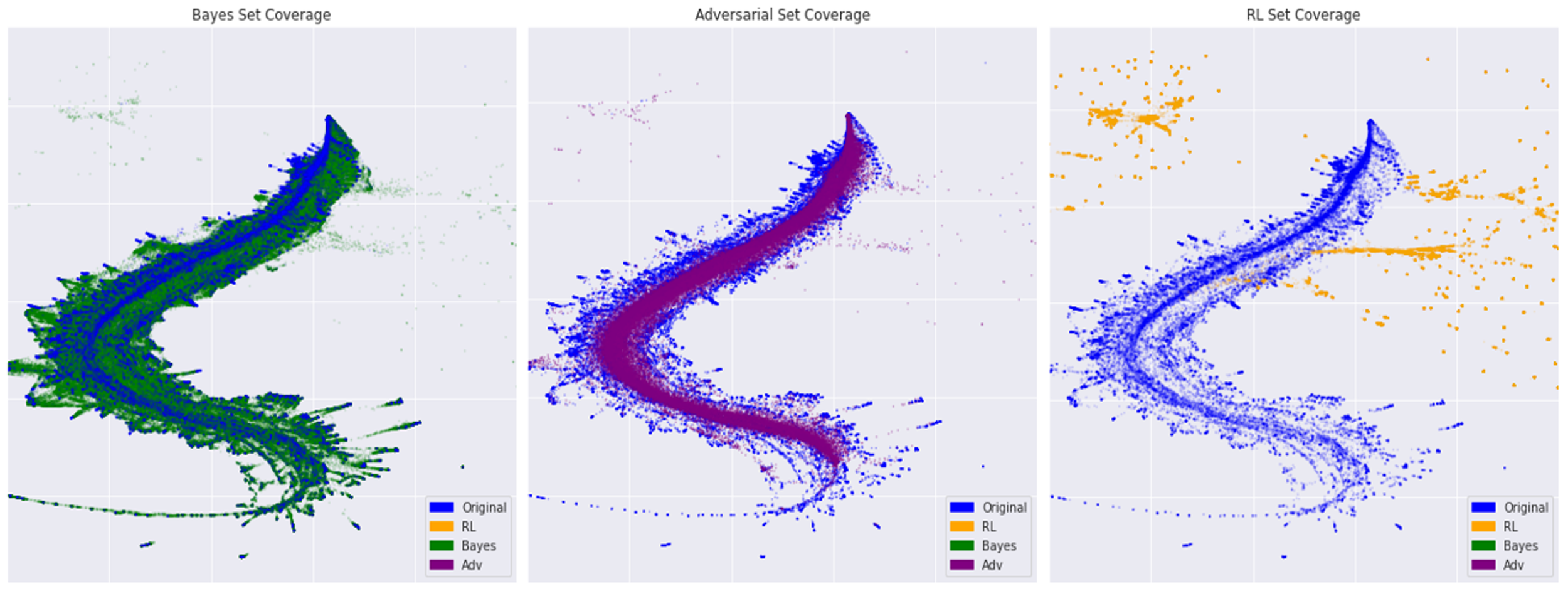
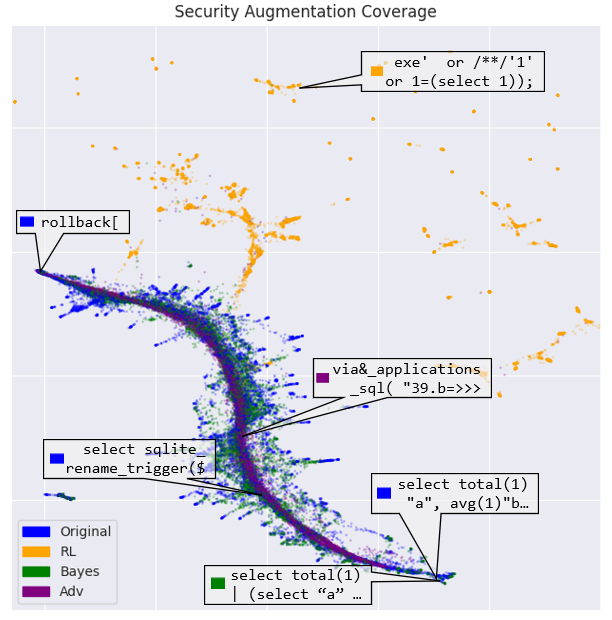
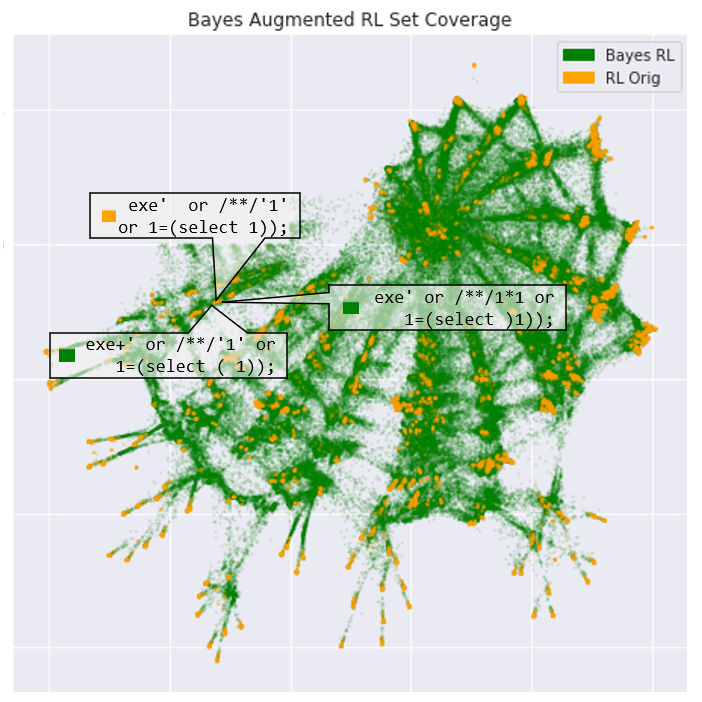
Our founder’s cyber research examined this problem directly by developing security-data augmentation methods based on Bayesian analysis, adversarial generation, and reinforcement learning. The work specifically investigated attack variants that preserve malicious behavior while moving outside the distribution represented by the original training data. That matters because a classifier can perform extremely well against a conventional test set and still fail against an attacker actively searching for an unseen representation of the same attack. The research showed that reinforcement-learning-generated samples could explore areas outside the original training distribution, exposing weaknesses that conventional in-distribution training would miss. Combined augmentation approaches significantly improved downstream defensive classification performance.
The lesson is larger than any single model: Cyber AI must be trained against an intelligent opponent, not merely against historical data.
RDT cyber moves beyond this work adapting more recent algorithm advances for data augmentation and exploitation.
Learn More
Synthetic Cyber Data
Create the data required to train the defense. Real cyber data presents a difficult engineering problem. Malicious events are comparatively rare. Sensitive network data may be difficult to share. Novel attacks may have little or no historical representation. And the datasets available to researchers frequently fail to capture the complexity of operational networks.
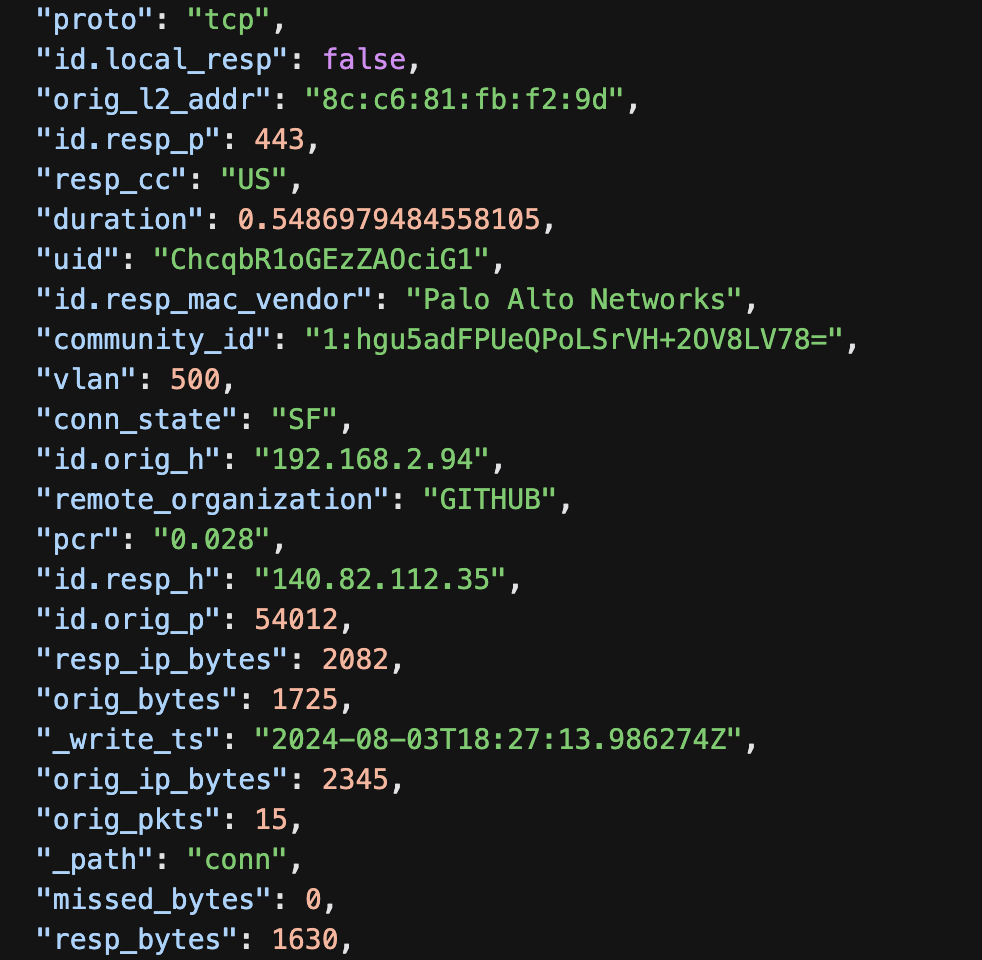
RDT's technical heritage includes the development of TabMT, a masked-transformer architecture for synthetic tabular data generation coauthored by our Founder and published at NeurIPS 2023. TabMT was explicitly evaluated on network-flow data and demonstrated the ability to model extremely large, complex NetFlow datasets. The research scaled from small datasets to more than 30 million NetFlow records while preserving complex relationships among fields.
In cyber applications, that capability can be used to generate realistic network traffic for training, simulation, testing, deception, and algorithm development—without requiring every experiment to depend on sensitive operational data. TabMT subsequently became a core technology in the Advanced Cyber Deception Framework.
Research → algorithm → cyber system. That progression is central to how RDT approaches technology development. RDT cyber moves beyond this work adapting more recent algorithm advances for tabular data generation.
Learn More
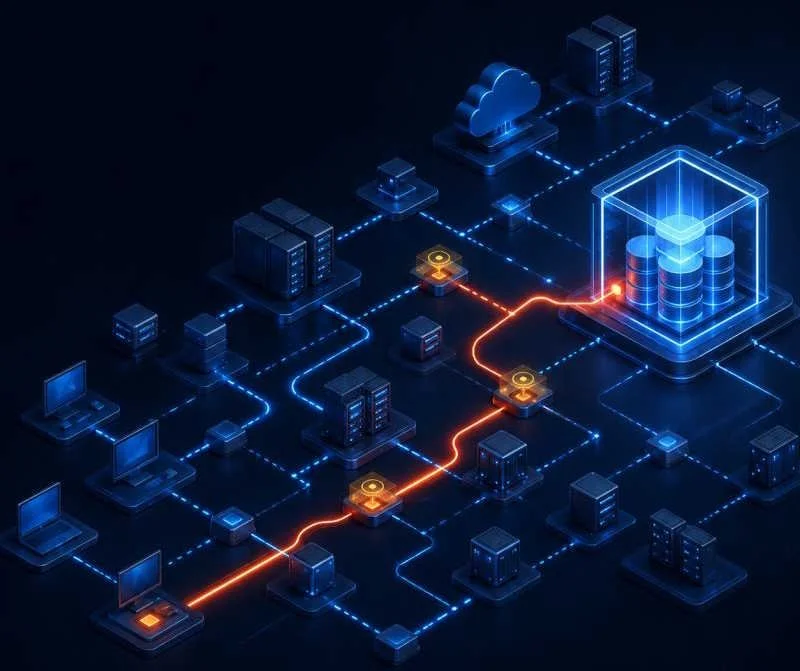
Cyber deception & active defense
If an adversary enters the network, control what they see. Cyber deception creates an environment in which an attacker cannot easily determine what is real, what is valuable, or whether their actions are being observed.
Dr. Roysdon coauthored the Advanced Cyber Deception Framework, which combines machine learning, intelligent honeypots, synthetic NetFlow generation, distributed agents, and command-and-control infrastructure to produce realistic deceptive network environments. The research specifically addresses a weakness of conventional honeypots: sophisticated attackers can often recognize artificial environments because their traffic and behavior do not resemble a real network. The resulting architecture generates realistic network behavior and replays it through distributed agents so that deceptive hosts exhibit credible activity rather than sitting passively waiting for an attacker. The research developed two complementary technologies: machine-learning-based traffic generation and network traffic replay, enabling the synthetic environment to evolve as the network changes.
RDT cyber moves beyond this work toward adaptive deception environments that gather intelligence while increasing uncertainty for the adversary.
Learn More